The Rise of Kalshi
What is Kalshi?
Kalshi is an online platform that allows people to trade the outcomes of real world events. Advertising is seen in sporting events, election races, and live betting. On Kalshi you can bet on a wide variety of things from crypto coin predictions to what NFL announcers will say on broadcasts. Unlike normal betting websites like Draft Kings or Fan Duel, Kalshi is completely legal in all 50 states as it is fully regulated by the CFTC (Commodity Futures Trading Commision), which is the same agency that regulates commodities and futures markets.
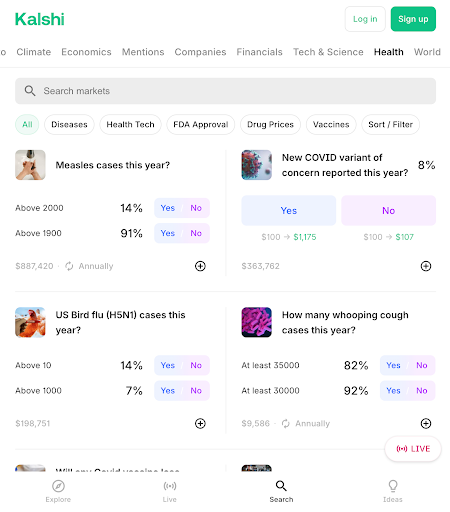
Kalshi operates on a simple Yes/No contract. On each event you can bet either yes the event will occur or no the event will not occur. This provides a level of simplicity that can make Kalshi extremely accessible and streamlines the interface for all users to use. One can spend up to $25,000 on most single contracts, with the possibility of more on certain high volume contracts where the maximum amount raises to a $7 million dollar limit.
To many this sounds like legalized betting and for regulators it can raise many difficult questions. Due to betting’s addictive nature and Kalshi’s wide spread availability, it draws many questions on where to draw the line between gambling, risk management, and information markets. Kalshi is able to capitalize on people’s uncertainty and gambling addictions.
Source: Kalshi
History
Kalshi first started in 2018 when it was founded by Tarek Mansour and Luana Lopes Lara. The CFTC (Commodity Futures Trading Commission) granted its status as a contract market in 2020 giving it the same status as future exchanges. As Kalshi has gained traction, it has attracted major venture funding and has been valued in the multi-billion dollar range.
Under the Commodity Exchange Act, the CFTC can disapprove any contracts that resemble illegal gambling or threaten public interest. As a result of this in 2023, the agency used this power to block Kalshi’s proposed contracts on election results, which were reasoned to be election gambling. Furthermore in 2024, Kalshi sued the CFTC that they overreached and such contracts were completely legal. The courts sided with Kalshi and opened the door for regulated election markets in the United States for the first time in decades. Most recently, on December 2, 2025, Kalshi announced that they raised a $1 billion funding round and were valued at $11 billion. This latest funding comes less than two months after the company announced $300 million of funding at a $5 billion evaluation. Certainly Kalshi has gained large amounts of popularity and is rapidly growing, however the company is under constant scrutiny and controversy.
Business Model and Market Power
Kalshi’s business model is simple and extremely scalable. It charges fees on each trade and settlement of event contracts. Furthermore, as trading volume goes up, especially around high stakes events, fee revenue increases significantly. Kalshi also does not rely on advertising or user data for monetization. The company competes with other sports books and betting platforms, however the more traditional platforms are regulated at the state level as gaming and are not legal in all states. They also compete with offshore or crypto based prediction markets like Polymarket, however those are not CFTC regulated. Kalshi has a clear advantage in the market as it is federally regulated and their rivals are limited to their markets. As Kalshi continues to grow, people can start to use Kalshi’s odds to help forecast future events which can give the company even more power.
Business Implications for Firms and Investors
Kalshi at the moment is a privately held company and does not trade on public exchanges. Businesses and companies can potentially use event contracts to hedge announcements, votes, or regulatory decisions that might affect their revenues. Corporate planners can also use market-implied probabilities to help supplement their decisions making. However, treating Kalshi prices and probabilities as the absolute truth is extremely unwise and risky and is better used as a supplement.
Conclusion
Kalshi’s rise showcases how monopolistic power in the digital age doesn’t always look like a single firm controlling prices. Whether event contracts ultimately resemble the future for information, regulated financial instruments, or sophisticated gambling will depend on choices made by courts, regulators, and market participants over the next few years and will be interesting to monitor.