AI’s Next Test: From Promise to Profit

Source: Fox Business
AI Trade Reignites
After a wave of highs and lows, the dominant AI trade has entered a new phase, pushing equity markets higher. Major indices, such as the Nasdaq Composite and the S&P 500, are reaching record levels, with the Nasdaq rising 1.64% and the S&P 500 1.05%, amid renewed confidence in the long-term economic potential of AI, following the extension of a U.S. ceasefire with Iran. NVIDIA and Microsoft are part of the Magnificent 7, a group of several companies that continue to lead this rally.
However, unlike past market rallies, this time is different. Investors no longer want promises; they want real proof.
Hype to Hesitation
While investors continue to look for answers, early signs of profitability are evident. In cloud computing and semiconductor demand, where companies pay to run AI tools online and firms purchase more chips to power these systems, many AI projects are just beginning to generate
revenue. Microsoft has begun monetizing AI through its Copilot integrations in Excel, which act as AI assistants that analyze, format, and visualize data using natural language prompts. NVIDIA continues to see strong growth from its AI chips that power modern artificial intelligence.
However, these gains are limited and do not reflect the sector's overall profitability.
At the same time, companies such as Amazon and Google are spending hundreds of billions of dollars on AI infrastructure, raising concerns about how quickly that investment will yield returns. With those “Magnificent 7” companies at the forefront, market performance has become more concentrated, leaving the broader market exposed to any potential declines.
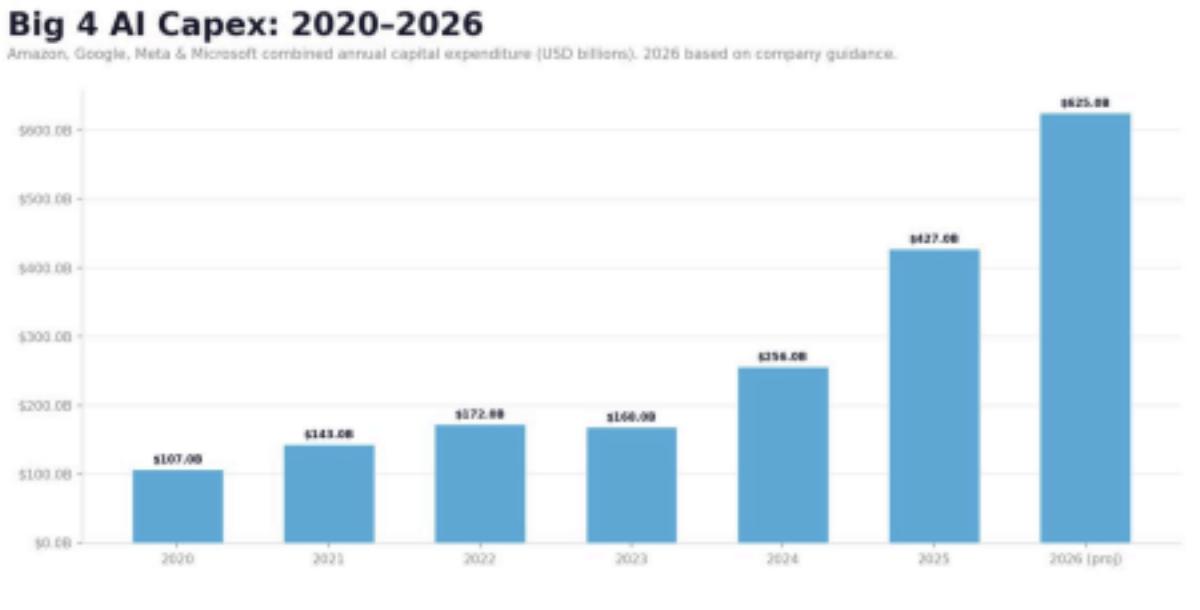
Amazon, Google, Meta, and Microsoft plan to spend $625 Billion on AI infrastructure in 2026.
Source: The Futurm Group Business Insider
Raising the Standard
Today, the AI trade has evolved into a new phase, and the conditions have changed. Top companies continue to lead market performance; however, expectations are much higher. Unlike the initial AI rally in late 2022 and early 2023, where markets were driven by investor optimism and future potential, instead they are now driven by measurable results.
Rather than pricing based on future possibilities, markets are increasingly valuing revenue growth, margin improvement, and clear monetization strategies from artificial intelligence. Analysts across Wall Street are emphasizing that companies need to shift from “building AI” to “earning from AI.”
This demonstrates that Artificial Intelligence is no longer speculative; it must now prove its value.
Uncertainty and Risk
With most of the attention focused on company performance, broader risks remain. Rising energy costs, essential for powering AI data centers, have led to higher operating expenses. This is among the few macroeconomic pressures that generate considerable uncertainty. Additionally, inflation and high interest rates could limit corporate spending, making it difficult for companies to justify large-scale investments in artificial intelligence in the future.
Along with macroeconomic risks, there is also uncertainty about the pace of AI adoption. While these companies continue to invest heavily, there is no clear timeline for widespread adoption of AI across all industries. This heightens the possibility that returns will take longer to appear than the market expects.
It is no longer about how AI will transform the economy with its limitless potential, but rather how quickly that potential can begin to generate profit.
Therefore, if these risks do affect it, AI’s profitability timeline will be pushed even further into the future, challenging investor confidence and exposing the fragility of a rally driven by expectations.
The Fall Back
Aside from the risks, many of these companies at the forefront of the AI industry, especially those in the Magnificent 7, do not rely entirely on AI for their success. Several companies, like Amazon and Microsoft, have diversified business models that have already proven revenue in other industries such as e-commerce and gaming. These sectors help companies stabilize their profit, while they handle uncertainty with the monetization of AI. While having options can reduce risk for individual companies, the broader market still relies heavily on AI-driven monetization, reinforcing the importance of effective execution across the industry.
When Expectations Meet Reality
Ultimately, the AI trade entering this new phase shows both confidence and uncertainty. Investors still believe in AI's long-term economic potential, but expectations are not enough to sustain these companies' current valuations. The next stage of this rally will rely heavily on the money AI can generate and the numbers that back it, rather than sitting back and looking at the potential of what AI could be. This means the market's greatest opportunity has also become its biggest challenge. In turn, higher investor expectations will not mark the end of AI trade but the beginning of a disciplined and sustainable one.