Commercial Real Estate Is on the Verge of a Major Rebound

Source: Metro Manhattan
A Slow Turning of the Tide in Commercial Real Estate
Commercial real estate (CRE) has spent the past three years as one of the U.S. economy’s weakest sectors, depleted by remote work, rising rates, and falling valuations, but beneath all the pessimism, a quieter shift is underway. Prices have become heavily discounted, new construction has slowed, and investor interest is gradually returning. These forces together suggest that a rebound in certain areas of CRE may come sooner than expected.
This is not to say a boom is guaranteed or right around the corner, as many structural challenges remain, especially in the office market. But the mix of lower valuations, restricted construction, improving leasing activity, and rising AI-driven demand is giving investors reasons to reconsider the sector, despite lasting uncertainty.
A Market That Has Become “Too Cheap to Ignore”
After years of uncertainty, valuations have fallen to a point where it is nearly impossible for major investors to ignore. Commercial property values are still about 17% below their 2022 peak. Office values are down 36% and apartment values are down 19%. Nonetheless, a steady increase has been seen since the second quarter of 2024.
This price correction is attracting large institutions back into the market. Pension funds, insurers, and asset managers have returned to their roles as net buyers. MSCI data shows that large investors have bought $4.6 billion more commercial property than they sold in 2025, marking their first net increase in commercial property holdings since before the pandemic.
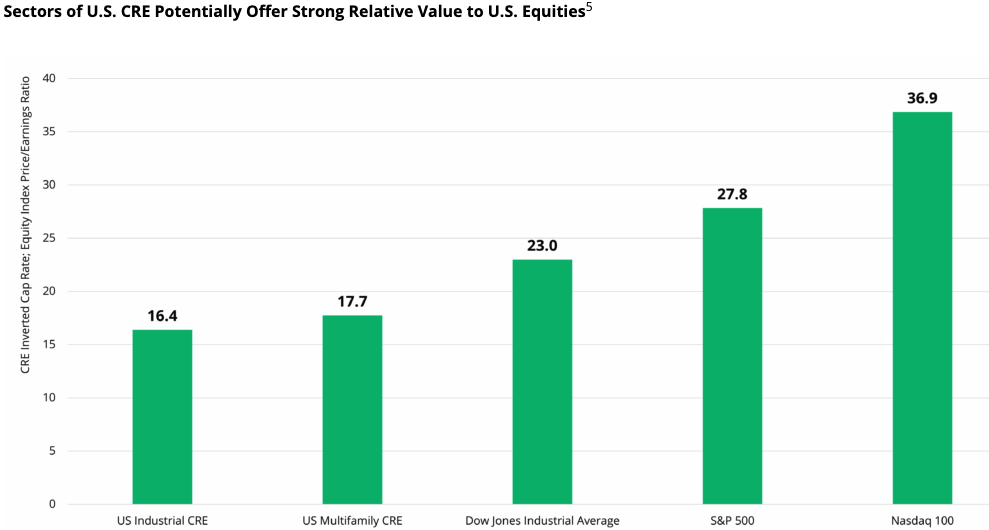
As CBRE’s co-head of U.S. and Canada capital markets, James Millon told the Wall Street Journal, “people are looking at commercial real estate now and see that it is relatively cheap versus other assets.” The affordability matters. Private real estate is now considered fairly valued again relative to corporate bonds. Public real estate investment trusts (REITs) are trading at their largest relative discount to the overall stock market in 20 years. For investors who are skeptical of the AI rally, this discount makes CRE even more appealing. Several experts predict that CRE could become a safe place for capital.
Source: Bridge Investment Group
Lower Rates Could Accelerate the Turnaround
The Federal Reserve’s recent rate cuts, along with expectations for another this month and possibly two more in 2026, have a more direct impact on CRE than on the housing market. Homeowners tend to be locked into 30-year fixed mortgages, but commercial property owners typically rely on floating rate loans or short-term debt. When rates fall, cash flows improve, valuations rise, and refinancing becomes less of a burden.
According to Hessam Nadji of Marcus and Millichap, the easing cycle will provide meaningful relief for borrowers. CBRE raised its market expectations following the September rate cut, signaling a shift in sentiment as borrowing costs decline. Analysts notably forecast refinancing to be one of the first areas to recover.
Lower rates do not guarantee higher property values because inflation and economic weakness still pose risks. Even so, falling borrowing costs establish a much stronger backdrop for CRE after multiple difficult years.
Supply Constraints Are Helping Existing Owners
Another underappreciated factor in the potential rebound is the standstill of new commercial construction. Building costs have risen more than 40% since 2020. To justify new projects at these costs, rents would need to rise at a similar pace, and they have not. As a result, development has become financially unrealistic.
Retail construction has barely increased over the past decade, and office development has slowed significantly. Developers essentially cannot break ground on new projects at current rent levels because tenants are not willing to pay premiums that would make the projects viable.
Since very few new buildings are being added, supply is tightening while demand shows promising signs of returning. This environment allows existing property owners to benefit from reduced competition and the potential for sustained growth. After years where weak demand dominated the narrative, limited supply has become one of the strongest forces working in favor of property owners.
Office Markets Aren’t Dead Everywhere
The office sector remains divided on the national scale, but New York City shows what a recovery can look like when conditions align correctly. Manhattan recorded 23.2 million square feet of new leasing in the first nine months of 2025, the highest level in 19 years. Large companies like Deloitte and Amazon have signed major leases in new, high-quality buildings. Although the national office market remains below pre-pandemic norms, Manhattan leasing activity has already surpassed 2018 and 2019 levels.
New York City also leads major metropolitan areas in its return-to-office rate, which is now higher than it was in 2019. The key point here is not that every office market will bounce back, but that quality, location, and business concentration can still drive significant demand. JPMorgan’s national outlook supports this view and highlights early signs of stabilization such as easing vacancy rates and more consistent leasing activity.
AI Is Powering a Surge in Industrial Outdoor Storage
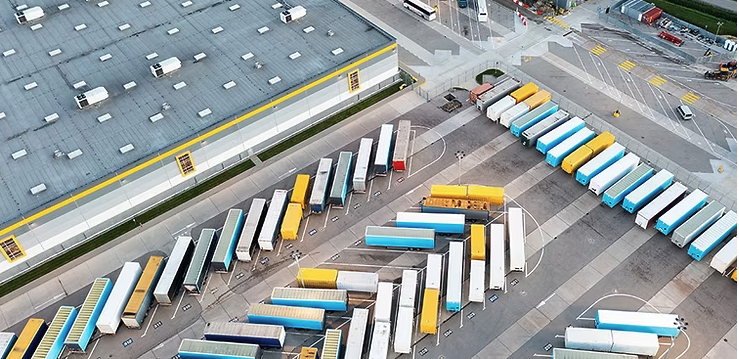
Artificial intelligence is influencing nearly every part of the economy in 2025. CRE is no exception. The rapid growth of data center construction has driven strong demand for industrial outdoor storage, a previously niche part of the commercial real estate world often called IOS. IOS refers to commercially zoned land used to store industrial equipment, trucks, and building materials.
IOS rents have increased 123% since 2020, and vacancy rates are sitting as low as 5% nationwide. Investment has surged from about $600 million between 2015 and 2020 to more than $4.7 billion since 2021. Large firms, including JPMorgan, Blackstone, and Truist, are now assembling sizable IOS portfolios across the United States and are investing hundreds of millions of dollars into the category.
These developments have made IOS one of the strongest sectors in today’s CRE market. Its rapid growth shows how the rise of data centers is already creating momentum in CRE, even while other segments continue to face pressure.
Source: ComReal
Investor Sentiment Is Beginning to Shift
Despite lingering risks, analysts and capital allocators are increasingly acknowledging that CRE may be entering a new era. Investors are beginning to distinguish between asset types that still carry heavy risk and those with strong fundamentals. Leasing activity and occupancy are showing signs of stability as we head into 2026, particularly in markets with limited new supply.
One important point for investors is that CRE is one of the few major asset classes in the United States that has already repriced significantly. If rates continue to fall and the economy remains stable, properties may be positioned to rebound earlier than many have expected.
Signs of a Quiet CRE Turnaround
Commercial real estate has spent years labeled as one of the weakest sectors in the U.S. economy. Several factors now indicate that a shift may already be underway. Prices have fallen far enough to attract major investors again. Construction of new buildings has largely decelerated. Demand is stabilizing in several office markets, while the growth of artificial intelligence is driving strong interest in industrial land surrounding data centers. Lower interest rates are also beginning to alleviate financial pressure on property owners with short-term or floating debt.
Although challenges remain and not every asset type will recover at the same pace, the combination of discounted valuations, limited supply, reviving leasing activity, and renewed investor interest has created conditions for a potential rebound. CRE is no longer the market to ignore. Rather, it is becoming a market to watch closely.
